
Gravity Casting Aluminum Parts Built to Your Drawings
Every gravity casting aluminum part we produce starts from your drawing, not from a catalog. Send us a 3D model or a 2D print – Pro-E, UG, SolidWorks, AutoCAD or PDF – and our engineers review wall sections, draft angles and machining stock before any tooling is cut. The part shown on this page is a 2 kg aluminum component, gravity cast and fully machined in one plant, with as-cast accuracy controlled to ISO 8062 CT4-CT6.
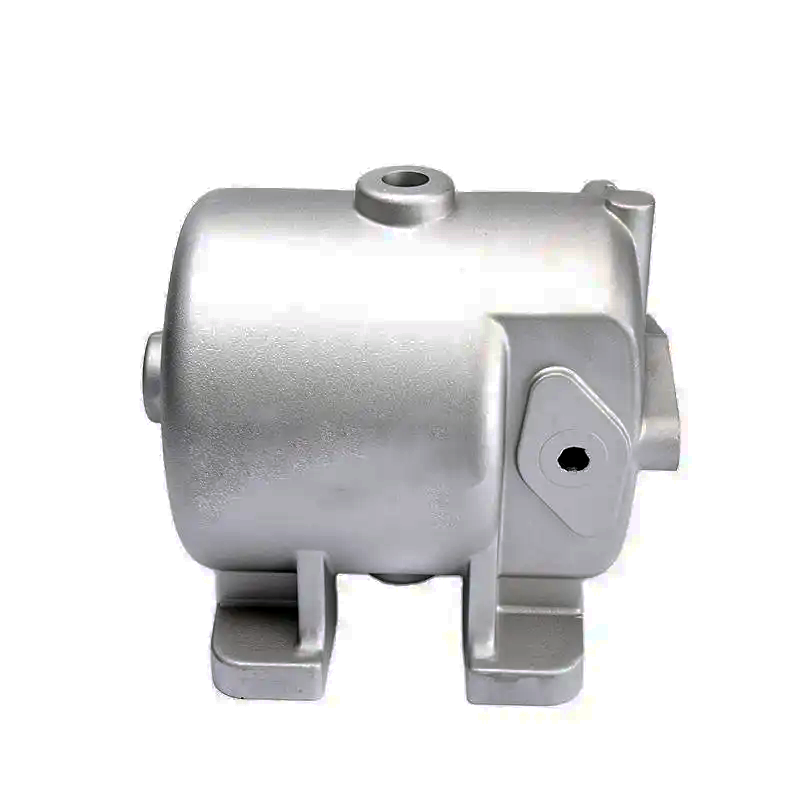
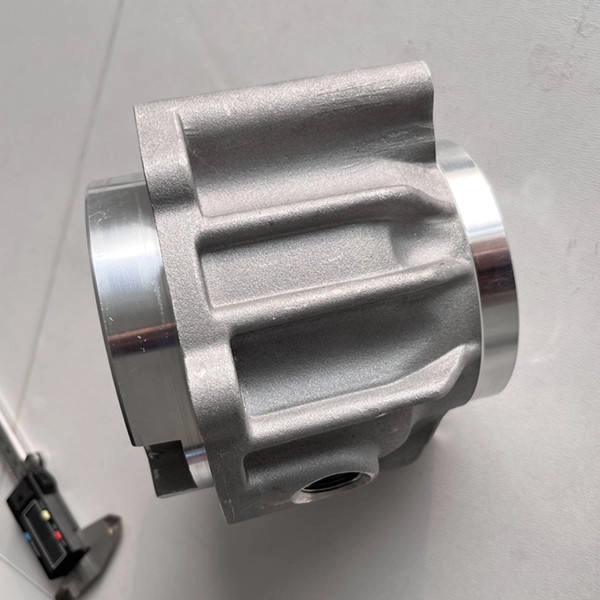
A Gravity Die Casting Process You Can Audit
We run the gravity die casting process with steel permanent molds on tilting machines. Molten aluminum enters the die under gravity alone – there is no high-pressure injection – so each casting solidifies with a fine, dense grain structure and very low gas porosity. Where the design needs internal channels, sand cores are loaded into the die before pouring.
Permanent Mold Casting Process, Step by Step
- Mold design and casting simulation for feeding and solidification
- Die coating and preheating to control the cooling rate
- Tilting gravity die casting – the machine rotates the die from horizontal to vertical so metal fills in a laminar stream, without turbulence

- Solidification, shakeout and gate removal
- Heat treatment (T5 / T6) when the drawing calls for it
- CNC machining, cleaning and final inspection
Why the Permanent Mold Casting Process Wins on Repeating Orders
A permanent mold is used thousands of times, so every gravity cast aluminum part in the batch keeps the same dimensions, surface finish and microstructure. Compared with sand casting you get tighter tolerances, a cleaner as-cast surface and a smaller machining allowance – exactly what keeps a 2 kg component economical in volume production.
Materials, Tolerances and Quality Control
Alloy selection follows your drawing and working condition – A356 / AlSi7Mg class alloys are typical for this process. As-cast dimensions are controlled to ISO 8062 CT4-CT6, and critical features are finished by in-house CNC machining. Quality control covers material verification, dimensional inspection, performance testing, inside-defect detection by X-ray, and balance testing for rotating parts, with ASTM, DIN, JIS, ISO and GB standards applied as the order requires.
Product Specifications
| Item | Capability |
|---|---|
| Processing | Casting + machining |
| Material | Aluminum (alloy per drawing) |
| Weight | 2 kg |
| Tolerance | Controlled by ISO 8062 CT4-CT6 |
| Design support | Pro-E, UG, SolidWorks, AutoCAD, PDF |
| Quality control | Material, dimension, performance, inside defects, balance test |
| Standard | ASTM, DIN, JIS, ISO, GB standards |
Common Alloys for the Gravity Die Casting Process: US / EU / AU / CN Grades
The gravity die casting process accepts a wide family of hypoeutectic and eutectic Al-Si alloys. Different markets call the same metal by different names, so the table below maps the grades our customers specify most often across the American (AA / ASTM), European (EN 1706), British (BS 1490), Australian (AS 1874) and Chinese (GB/T 1173) systems. Quote it to your local standard and we pour to match.
| Alloy family | US (AA / ASTM) | Europe (EN 1706) | UK (BS 1490) | Australia (AS 1874) | China (GB/T 1173) |
|---|---|---|---|---|---|
| AlSi7Mg0.3 | A356.0 (356.0) | EN AC-42100 | LM25 | 601 (DA601) | ZL101A (ZL101) |
| AlSi7Mg0.6 | A357.0 | EN AC-42200 | – | – | ZL114A |
| AlSi10Mg | 360.0 | EN AC-43400 | LM9 | – | ZL104 |
| AlSi12 (eutectic) | – | EN AC-44200 / 44100 | LM6 | – | ZL102 |
| AlSi5Cu1Mg | 355.0 / C355.0 | EN AC-45300 | LM16 | – | ZL105 / ZL105A |
| AlSi6Cu4 | 319.0 | EN AC-45000 | LM21 | – | ZL107 |
| AlSi5Cu3 | 328.0 | EN AC-45400 | LM27 | – | ZL106 |
| AlSi12CuMgNi | 336.0 | EN AC-48000 | LM13 | – | ZL109 |
JIS cross-reference for the same families: AC4C / AC4CH (AlSi7Mg), AC4A (AlSi10Mg), AC4D (AlSi5Cu1Mg), AC2B (AlSi6Cu4), AC8A (AlSi12CuMgNi). Grades shown are nearest cross-standard equivalents – composition limits differ slightly between standards, so the final alloy and temper are always specified per your drawing. That is why our material call-out reads “Customer Requirements”: send the standard you work to, and the gravity cast aluminum component arrives certified to it.
How to Choose the Alloy for Your Gravity Cast Aluminum Part
- Strength and ductility first – AlSi7Mg0.3 (A356.0 / EN AC-42100 / ZL101A) in T6 is the default structural choice
- Higher-strength premium castings – AlSi7Mg0.6 (A357.0 / EN AC-42200 / ZL114A) when the drawing asks for more
- Leak-tight housing – eutectic AlSi12 (LM6 / ZL102) for pressure-tested, non-heat-treated parts
- Complex thin walls – AlSi10Mg (ZL104) where fluidity matters more than peak strength
- Heavy machining and hot service – AlSi-Cu family (355.0 / 319.0 / ZL105A) trades some ductility for hardness
- All-round general engineering – AlSi6Cu4 (319.0) and AlSi5Cu3 (328.0) keep cost down on mixed work
- High-temperature rotating parts – piston alloy AlSi12CuMgNi (336.0 / ZL109)
Typical Applications for Aluminum Gravity Cast Components
Aluminum gravity cast components of this weight class serve automotive and general machinery: brackets and housings, pump and valve bodies, compressor parts, impellers and pulleys. The balance test in our QC list exists precisely for rotating parts, where even a small casting void would show up as vibration in service.
Frequently Asked Questions
What do you need to quote a gravity casting aluminum part?
A 3D model or 2D drawing, the alloy (or let us propose one), estimated annual quantity, and any machining or testing requirements. We reply with a casting-feasibility summary, tooling cost and piece price.
Which tolerance can you hold as cast?
As-cast accuracy on this gravity die casting process is controlled to ISO 8062 CT4-CT6. Features that need tighter limits are finished by CNC machining to your drawing.
Can you supply fully machined and tested parts?
Yes. Casting and machining sit in one plant, so the part arrives finished: material certificates, dimensional reports, X-ray films for inside defects and balance test records ship with the order on request.
Do you support low volumes or only mass production?
Both. Permanent mold tooling stands up to long runs, so the same gravity cast aluminum part tooling can cover prototypes, pilot lots and annual programs without changing the process route.
Request a Quote
Send your drawing and quantity to our sales team. You will get a straight answer on castability, tooling and price – whether you need a single gravity cast aluminum component or a running program of aluminum gravity casting parts all year.
