High Frequency Induction Quenching Process:
Induction heating is a non-contact heating process which utilizes the principle of electromagnetic induction to produce heat inside the surface layer of a work-piece. By placing a conductive material into a strong alternating magnetic field, electrical current can be made to flow in the material thereby creating heat due to the I2R losses in the material. In magnetic materials, further heat is generated below the curie point due to hysteresis losses. The current generated flows predominantly in the surface layer, the depth of this layer being dictated by the frequency of the alternating field, the surface power density, the permeability of the material, the heat time and the diameter of the bar or material thickness. By quenching this heated layer in water, oil or a polymer based quench the surface layer is altered to form a martensitic structure which is harder than the base metal.
High Frequency Induction Quenching Definition:
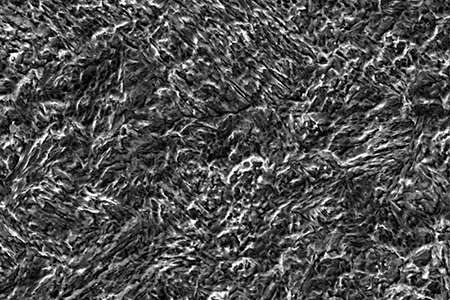
A widely used process for the surface hardening of steel. The components are heated by means of an alternating magnetic field to a temperature within or above the transformation range followed by immediate quenching. The core of the component remains unaffected by the treatment and its physical properties are those of the bar from which it was machined, whilst the hardness of the case can be within the range 37/58 HRC. Carbon and alloy steels with equivalent carbon content in the range 0.40/0.45% are most suitable for this
High Frequency Induction Quenching Process:
A source of high frequency electricity is used to drive a large alternating current through a coil. The passage of current through this coil generates a very intense and rapidly changing magnetic field in the space within the work coil. The work piece to be heated is placed within this intense alternating magnetic field where eddy currents are generated within the work piece and resistance leads to Joule heating of the metal. This operation is most commonly used in steel alloys. Many mechanical parts, such as shafts, gears, and springs, are subjected to surface treatments, before the delivering, in order to improve wear behavior. The effectiveness of these treatments depends both on surface materials properties modification and on the introduction of residual stress. Among these treatments, induction hardening is one of the most widely employed to improve component durability. It determines in the work-piece a tough core with tensile residual stresses and a hard surface layer with compressive stress, which have proved to be very effective in extending the component fatigue life and wear resistance.
Induction surface hardened low alloyed medium carbon steels are widely used for critical automotive and machine applications which require high wear resistance. Wear resistance behavior of induction hardened parts depend on hardening depth and the magnitude and distribution of residual compressive stress in the surface layer.
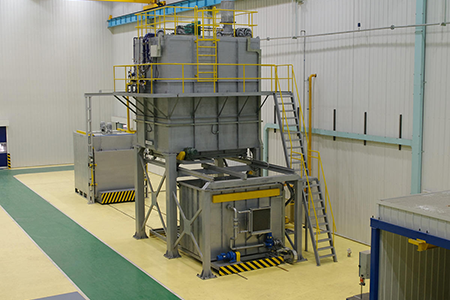
High Frequency Induction Quenching Equipment:
A-Power required:
Power supplies for induction hardening vary in power from a few kilowatts to hundreds of kilowatts depending on the size of the component to be heated and the production method employed i.e. single shot hardening, traverses hardening or submerged hardening.
In order to select the correct power supply it is first necessary to calculate the surface area of the component to be heated. Once this has been established then a variety of methods can be used to calculate the power density required, heat time and generator operating frequency. Traditionally this was done using a series of graphs, complex empirical calculations and experience. Modern techniques typically utilize finite element analysis and Computer-aided manufacturing techniques, however as with all such methods a thorough working knowledge of the induction heating process is still required.
For single shot applications the total area to be heated needs to be calculated. In the case of traverse hardening the circumference of the component is multiplied by the face width of the coil. Care must be exercised when selecting a coil face width that it is practical to construct the coil of the chosen width and that it will live at the power required for the application.
B-Frequency:
Induction heating systems for hardening are available in a variety of different operating frequencies typically from 1 kHz to 400 kHz. Higher and lower frequencies are available but typically these will be used for specialist applications. The relationship between operating frequency and current penetration depth and therefore hardness depth is inversely proportional. i.e. the lower the frequency the deeper the case.
Examples High Frequency Induction Quenching for various case depths and material diameters
| Case depth [mm] | Bar diameter [mm] | Frequency [kHz] |
| 0.8 to 1.5 | 5 to 25 | 200 to 400 |
| 1.5 to 3.0 | 10 to 50 | 10 to 100 |
| >50 | 3 to 10 | |
| 3.0 to 10.0 | 20 to 50 | 3 to 10 |
| 50 to 100 | 1 to 3 | |
| >100 | 1 |
The above table is purely illustrative, good results can be obtained outside these ranges by balancing power densities, frequency and other practical considerations including cost which may influence the final selection, heat time and coil width. As well as the power density and frequency, the time the material is heated for will influence the depth to which the heat will flow by conduction. The time in the coil can be influenced by the traverse speed and the coil width, however this will also have an effect on the overall power requirement or the equipment throughput.
It can be seen from the above table that the selection of the correct equipment for any application can be extremely complex as more than one combination of power, frequency and speed can be used for a given result. However in practice many selections are immediately obvious based on previous experience and practicality.
For expert High Frequency Induction Quenching service, please contact sales@leesh.cn, or call us directly +86 135 1608 5845