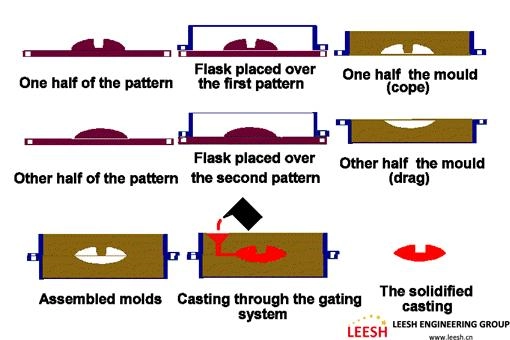
What type of sands are used for sand casting process?

casting process choose

Green Sand
Green sand refers to the sand molds formed from wet sand and is sometimes referred to as clay or Casting coal. The sand mold is in an uncured state as the metal is being poured. Sand Casting using green sand is quick and inexpensive, since the sand can be reused. The downside is that the sand is a soft mold and can collapse or shift during casting, leaving an unusable cast. However, the process is reliable enough that it has survived for centuries and is still used today.
Sodium Silicate or Water Glass
Sodium silicate can also be used to create the mold casting. Sodium Silicate can quickly go from a liquid to a solid by passing carbon dioxide through it. This causes the sodium silicate to dehydrate. This process is extremely useful when a cavity is required within the casting. Though sodium silicate can create a solid core for the casting, it must be mixed with other materials to allow the breakdown after casting so the core can be removed. If the mixture isn’t correct the core will become lodged within the casting, causing the casting to be useless.
Resin Sand
Once mixed and heated, resin sand becomes a solid mold with a smooth surface. A solid mold means fewer defective castings, but the disadvantage is a higher cost and slower production rate. Where green sand molds are quick to create, resin sand molds take more time since each must be mixed and burned to create the perfect mold. The cost of resin sand is much greater and, though the resin can be reused, it constantly needs to be replenished. This makes the process more costly.
Heat Treatment | Leesh Holdings Heat Process & Quality Guide
Heat Treatment Training Seminar Heat Treatment Training Seminar CopyRight@Leesh...
Read More
ISO8062
ISO8062 & VDG P690 Casting Dimensional Tolerance Standards
Comprehensive casting tolerance guide: ISO 8062 (GB/T6414) CT5-CT7 linear tolerances, VDG P690 investment...
Read More
Abrasion Resistant White Iron
Abrasion Resistant White Iron Castings ASTM A532 / A532M
Abrasion Resistant White Iron Castings ASTM A532 / A532M Method of Manufacture These alloys may...
Read More
CopyRight Declaration
Dear all attention: All molds/moulds/toolings and drawings are the assets and property of our customers....
Read More
Merry Christmas and a happy and prosperous 2026
As 2025 draws to a close, we want to take a moment to thank our outstanding team, trusted customers,...
Read More
Leesh Holdings Tin Bronze Part
GOST 613-79 Tin Bronze Tin Foundry Bronzes
GOST 613-79: Tin Foundry Bronzes Standard GOST 613-79: Tin Foundry Bronzes. Grades Standard Information Standard...
Read More
Martensitic Stainless Steel Microstructure-1
ZG06Cr13Ni5Mo High Strength Martensitic Stainless Steel
ZG06Cr13Ni5Mo High Strength Martensitic Stainless Steel Castings International Equivalent Grades:Chinese...
Read More
T6 furnace
Gravity Die Casting T6 Treatment - for Superior Performance
Leesh is a key player in the Gravity Die Casting with specialized experience, enhanced with T6 heat treatment...
Read More
Induction Hardening
Induction Hardening from Leesh Professional Services
Leesh Holdings Co., Ltd. (Leesh), a leading engineering and manufacturing company based in Shenyang,...
Read More
machining roughness
The Difference Between Surface Roughness and Surface Finish
Understanding the Difference Between Surface Roughness and Surface Finish In the field of mechanical...
Read More
Scroll to Top